Volunteer vs Employee: The Tension No One Talks About

The fair is forty-eight hours away.
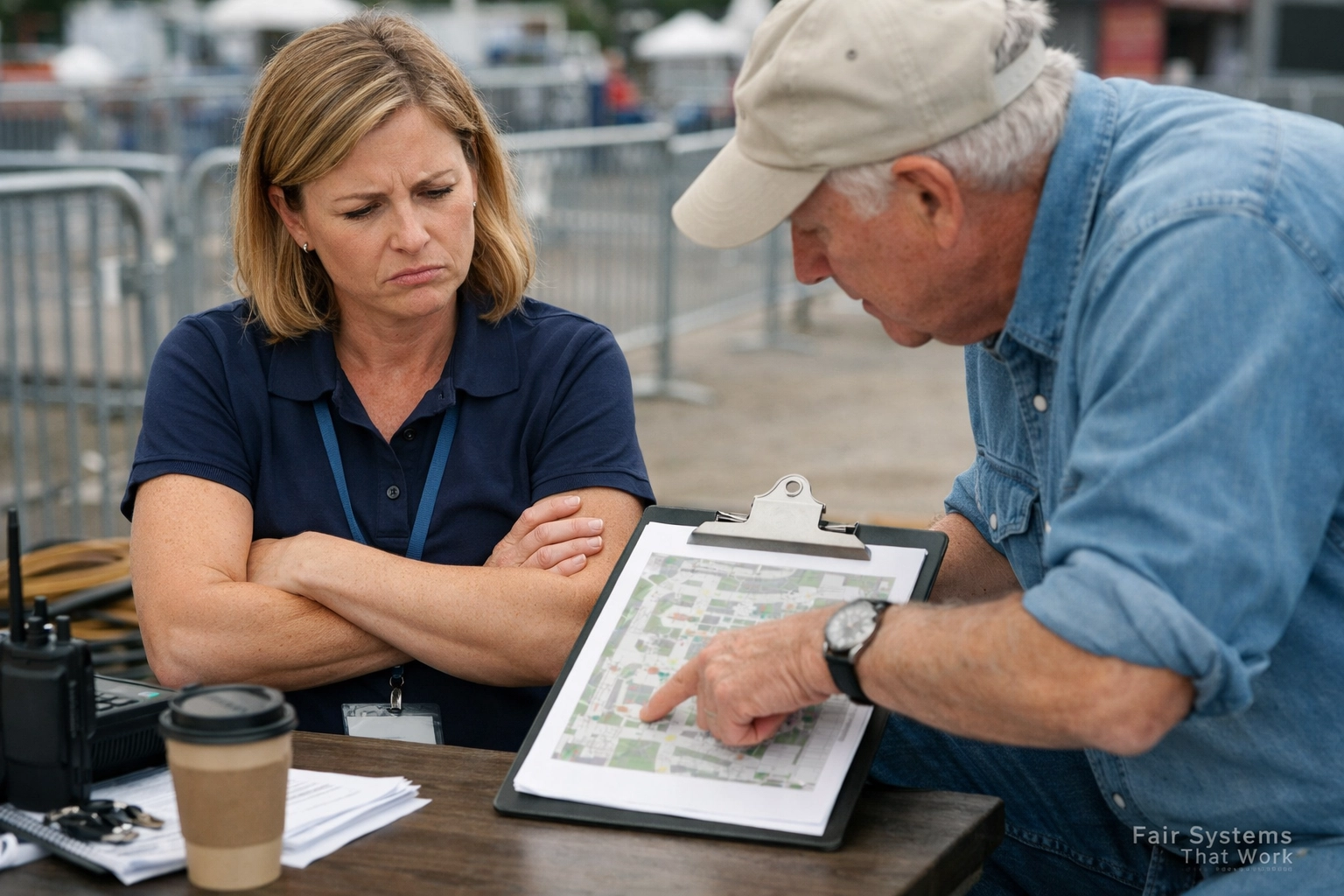
Sarah, the Fair Manager, has a layout that actually works, and she has built it for the fair you are running now. Power. gates. lineups. food trucks. Even the wind direction, because nobody wants the barns to gas out the mini donuts.
Then Dave shows up.
Dave is the Board President, with thirty years as a volunteer and a highlight reel in his head. Dave is the hero of his own story. He has saved this fair with duct tape, baler twine, and pure stubbornness, and honestly, that history counts.
Sarah is not in that story.
Dave looks at the ticket booth, pauses like he is judging a pie contest, and decides it is wrong. He grabs two volunteers, finds a tractor, and moves the booth ten feet to the left because that is what he has always done. He is not asking. He is fixing.
Ten feet.
Right onto the main electrical run for the gate scanners.
Sarah finds it and does the math in her head, the kind that makes your stomach drop. No power means no scanners. No scanners means lineup chaos. Lineup chaos means angry patrons who swear they are never coming back, and they say it loud enough for Facebook to hear.
She tells Dave.
Dave shrugs like this is a fun little suggestion, not a problem with actual wires. He says, We always put it there.
Sarah says, We did not have digital scanners ten years ago.
Dave does not raise his voice. He does not swear. He just lands the line that changes the temperature in the room. We are volunteers, and we are here when we have a lot of other things on the go.
It is subtle.
It is also a little threatening, because it quietly reminds Sarah who has the power to disappear when it gets inconvenient.
Sarah hears it as, You are lucky we are even here.
Dave hears it as, You should be grateful.
And there it is. The classic fair standoff, except now it is not just about a booth. It is about status.
This is not about a booth. This is about who gets to drive the plan.
Why This Happens Every Single Season
This isn’t a personality problem. This is a role problem. It is what happens when two operating systems are trying to run the same event, at the exact same time.
It is muscle memory.
When someone has been a working volunteer forever, they solve problems by doing, because that is how you survive fair week. They grab the tractor, move the thing, patch the hole, and carry on, and half the time that attitude is the only reason the gates open.
But when you hire staff, the game changes, because now the plan has dependencies. Vendors, permits, safety rules, scanners, staffing, and timelines that do not care how many years you have been showing up.
Board leads. Staff runs.
When the board keeps operating like a volunteer crew, staff ends up managing surprise decisions instead of managing the fair, and that is when everything turns into a scramble.
That kills momentum.
It also kills trust.
5 Common Tensions in Fair Governance
If you have a Sarah and Dave situation, you usually also have these little gems:
Board members acting like they are the ones emptying the trash.
The manager has seventeen bosses instead of one.
A board member going rogue and giving orders to the summer student.
We have always done it this way, versus actually this way makes money.
Blurring the line between board and manager, and eroding the role completely.
The Part Nobody Wants to Talk About
Blurred roles feel harmless. It looks like help. It’s not. And when you are short on hands, help feels like a gift.
But the cost stacks up fast, especially when the help comes with authority attached, even unspoken authority.
When staff get second-guessed, they stop taking initiative because why bother? When the board hovers, staff stop telling the truth because it is not safe. When everyone gives directions, nothing is clear, so everything gets delayed.
And that volunteer line, the one that sounds polite, can land like a warning. It can turn into, We can walk away whenever we want, so do not push us. You do not have to say it out loud for everyone to feel it.
And yes, there is a real legal and insurance angle here. When roles blur, accountability blurs. When accountability blurs, claims get messy, and messy claims turn into meetings you do not have time for.
Not the fun kind.
The Balcony Rule
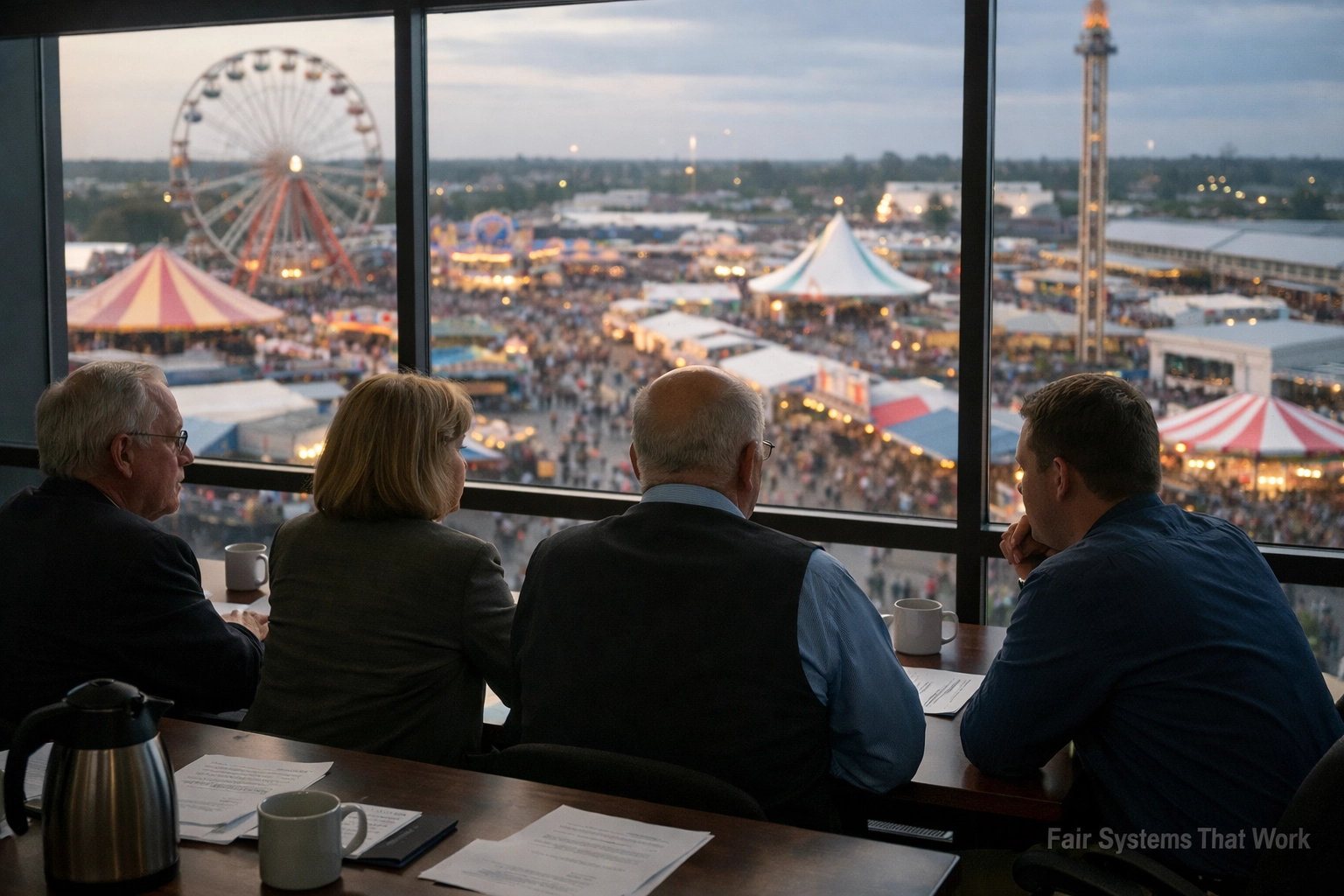
Think of your fair like a show, because it basically is, just with more dust and fewer sequins.
The board is on the balcony watching the big picture. Budget. risk. priorities. community impact. The board decides what matters most, and what the fair will not compromise on.
Staff are backstage making the doors open on time, with radios, checklists, keys, and the kind of calm you only get from knowing the plan is actually the plan.
When the board runs backstage during setup, the show falls apart.
5 Practical Fixes to Protect Your Fair
None of this is complicated. It just has to be done on purpose.
Get the board out of the weeds and into the strategy room.
Pick ONE person to talk to the manager. Just one.
Write down exactly where the board power stops.
Give the board a report they actually understand, so they stop hovering.
Do a reset every year so the Daves know their new role.
Do this and the fair gets lighter.
Less tug of war. Less surprise tractor energy. More calm. More follow-through. More money stays on the table.
If this feels familiar, it’s not because your people are the problem. It’s because your structure is. Fix the structure, and everything else gets lighter.
Fix Your Fair Before It Breaks Again.
Comments