The Pre-Season Fair Quick Check-Up: Is Your Board Ready or Just Running on Fumes?
- Kryssie Thomson

- Mar 10
- 6 min read
The snow is melting, the days are getting longer, and that familiar knot is tightening in your stomach.
It’s the pre-season "quiet panic."
You look at the calendar and realize the fair is only a few months away, but the to-do list looks exactly like it did last year.
Most boards mistake activity for progress.
They think that because everyone is busy and stressed, they must be getting ready.
But there is a massive difference between a board that is prepared and a board that is just running on fumes.
One ends the season with a celebration; the other ends it in a hospital bed or a resignation letter.
Let’s take a look at where your board actually stands before the gates open.
The "Binder Person" Test: Does Knowledge Live in a Person or a System?
Every local ag society has one.
The person who knows exactly which breaker flips when the corn dog stand plugs in too many fryers.
The person who remembers where the "extra" keys to the cattle barn were hidden in 1994.
They carry the entire fair in their head like a mystical, dusty library.
It feels good to have an expert on speed dial.
Until it doesn’t.
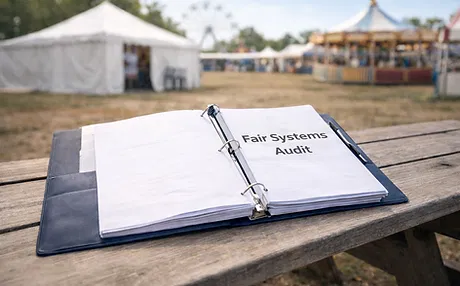
What happens if that person takes a vacation, gets sick, or, heaven forbid, decides they’ve had enough?
When your operational knowledge lives in a human brain instead of a shared system, you aren't running an organization.
You are running a hostage situation.
I see this in almost every community exhibition I visit.
The board relies on "Bob" or "Sarah" to solve every crisis because "that's how we've always done it."
This creates a massive bottleneck.
It also prevents new people from stepping up because they feel like they’ll never know as much as the "Binder Person."
If your fair’s survival depends on one person’s memory, your system is broken.
Real readiness means having those secrets written down, mapped out, and accessible to the whole team.
Documentation isn't just paperwork; it’s an insurance policy for your sanity.
neighbour
The "Wait and See" Volunteer Trap: Are New People Standing Around?
You finally convinced a neighbour to come help out on a Saturday morning.
They show up at 8:00 AM, eager and ready to work.
But when they arrive, the board members are all huddled in a circle discussing something that happened three years ago.
The new volunteer stands by the gate, hands in their pockets, waiting for someone to tell them what to do.
Thirty minutes go by, and they are still waiting.
By 9:00 AM, they’ve checked their phone ten times and decided they’d rather be at home mowing their own lawn.
They leave, and they never come back.
Then the board complains that "nobody wants to volunteer anymore."
The truth is, people want to help, but they don't want to beg for instructions.
If your board doesn't have a clear list of ready-to-go tasks, you are burning your most valuable resource.
Most fairs wait until the volunteer arrives to figure out what they should do.
That is a recipe for high turnover and low morale.
A ready board has a "menu" of jobs that can be handed out in thirty seconds.
If a volunteer has to wait more than five minutes for a task, you’ve already lost them.
colours
The "Meeting Loop" Check: Are You Deciding or Just Discussing?
We’ve all been in that meeting.
It’s 9:15 PM on a Tuesday, and the board has spent forty-five minutes debating the colour of the napkins for the volunteer dinner.
No decision has been made.
Someone suggests we "wait and see" what the other vendor says.
The meeting ends with a plan to talk about it again next month.
This is the "Meeting Loop," and it is where fair spirit goes to die.
When a board is running on fumes, they lose the ability to make hard choices.
They default to endless discussion because it feels like work, but it carries no risk.
The problem is that the "Extension Cord Octopus" doesn't care about your napkin colours.
Why hope isn't a fire safety plan is a lesson many learn too late.
If your meetings are longer than ninety minutes and you haven't checked off at least five major decisions, you are looping.
Ready boards focus on "Decision Points."
They go in with the goal of saying "Yes," "No," or "Not this year."
Anything else is just a coffee klatch with higher stakes.
Stop talking about the work and start authorizing the work.
The "Three-Person" Rule: Are the Same Three People Doing Everything?
Take a look at your last work bee.
Who was actually holding the hammer, moving the bleachers, and picking up the trash?
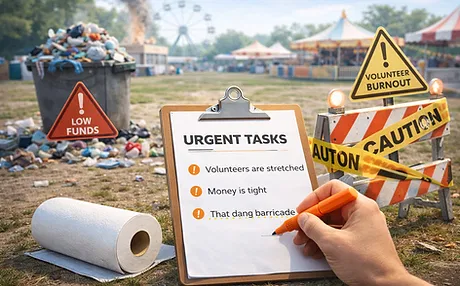
If it’s the same three people who are also the President, the Secretary, and the Treasurer, you are in the "Three-Person Trap."
This is the most common sign of a board about to collapse.
These three people are the "super-volunteers" who carry the entire weight of the ag society on their backs.
They do it because they care, but also because they don't know how to stop.
@FairSystemsThatWork
The danger here isn't just burnout; it's exclusion.
When three people do everything, everyone else feels unnecessary.
The rest of the board becomes "spectators" who just show up for the snacks.
Eventually, the three leaders get resentful.
They start making comments like, "Must be nice to just show up and watch."
This toxicity spreads through the organization like a weed.
A healthy board spreads the load, even if it means things take a little longer or aren't done "perfectly" the first time.
If your "Big Three" went on strike tomorrow, would the gates even open?
If the answer is no, your fair is a house of cards.
Real leadership is about building a team that can function without you.
behaviour
The "Shadow" Factor: Does Every Lead Have a Backup?
Who is in charge of the gate?
Who manages the vendors?
Now, tell me who does those jobs if the main person gets the flu on opening morning.
If you don't have a name for the second person, you have a single point of failure.
In fair life, things go wrong.
The "Shadow" Factor is the simplest way to test your board's resilience.
Every key role should have a "Shadow": someone who follows the lead, learns the ropes, and can step in at a moment's notice.
Most boards resist this because the "Leads" like being the experts.
It feels powerful to be the only person who knows how the water system works.
But that power is a liability for the community exhibition.
We need to stop rewarding "lone wolf" behaviour and start rewarding mentorship.
Shadowing isn't about replacing someone; it’s about protecting the event.
If you are the only one who knows how to do your job, you haven't succeeded: you’ve created a risk.
Getting Off the Treadmill
If you read through this checklist and felt a sinking feeling in your chest, you aren't alone.
Most fair boards are running on fumes right now.
The good news is that systems can be built, even when the clock is ticking.
You don't have to keep doing it the hard way.
Imagine a fair where the "Binder Person" can actually enjoy a corn dog because their knowledge is on a shared drive.
Imagine a meeting that ends early because decisions were actually made.
That isn't a fantasy; it’s just the result of a Fair System That Works.
If you are ready to stop the "quiet panic" and start building a board that lasts, let's get to work.
We can help you move from chaos to a clear, documented strategy that saves your sanity.
Join our community and get the support you need before the season hits full speed.
Check out our templates and toolkits to start documenting your "Binder Person" secrets today.
You can also join the conversation in our Facebook Group, where fair leaders just like you share what’s actually working on the ground.
If you really want to transform your board in time for this year, look into our 60-Day Strategy Build program.
It’s designed to take you from "fumes" to "functional" in the shortest time possible.
Don't wait until the week before the fair to realize you're exhausted.
Reach out to me directly at Support@fairsystemsthatwork.com or fill out our contact form.
Let’s make sure this season is the one where you finally get to breathe.
@FairSystemsThatWork
Comments